Oil is going up because markets are pricing in supply risk. Right now, traders are reacting to the chance of disrupted production, interrupted tanker traffic, and a wider regional conflict that could hit one of the world’s most important oil-export routes. That risk premium has pushed Brent above $100 a barrel and WTI close to $100.
Oil prices usually move before barrels actually disappear from the market. Traders do not wait for a full shutdown. They reprice oil as soon as they see a credible threat to producers, export terminals, pipelines, storage sites, ports, or tankers.
That is why war can lift prices so quickly. The market reacts to two things at once: real shortages and fear of future shortages. Even if supply is still moving, the possibility of losing part of it can be enough to send futures higher, widen volatility, and raise shipping and insurance costs.
The current surge is tied to the escalating war involving Iran, the United States, and Israel. The conflict has raised fears around attacks on Gulf energy infrastructure, retaliation against regional producers, and further disruption to shipping in and around the Strait of Hormuz. Iran has threatened to close the strait entirely if attacks on its energy and coastal assets continue, while Gulf operators have already reported export and shipping disruption.
This matters because the region is not just another oil-producing area. It is a core export hub. The market is not only worried about Iranian output. It is worried about whether oil from multiple Gulf producers can leave the region safely and on time.
The Strait of Hormuz is the narrow waterway linking the Persian Gulf to the open ocean. It is one of the most important oil chokepoints in the world because a huge share of globally traded crude and petroleum liquids passes through it. In 2024, flows averaged about 20 million barrels a day, roughly 20% of global petroleum liquids consumption.
It matters so much because there are limited alternatives. Some pipeline capacity exists outside the strait, mainly through Saudi Arabia and the UAE, but it cannot fully replace normal seaborne volumes if the route is seriously disrupted. That is why even a threat to shipping through Hormuz can move prices sharply.
The market is pricing in the possibility that production or exports from the Gulf could be interrupted. That alone can lift futures quickly.
When tankers face missile risk, mines, or military escalation, shipping becomes slower, more expensive, and less predictable. Those costs feed into crude pricing fast.
Oil is one of the world’s most actively traded commodities, so geopolitical headlines can trigger heavy positioning by traders, funds, and hedgers. That can magnify price swings beyond the immediate physical disruption.
Markets are not only looking at Iran. They are asking whether the conflict could spread to other producers, export terminals, or regional infrastructure. That broader fear is part of the price move.
The more severe the disruption, the harder it becomes for alternative routes, emergency stock releases, or other producers to fully offset the lost barrels. That keeps the upside risk alive.
Higher oil prices usually show up first at the pump. Gasoline and diesel often rise when crude stays elevated, and that can filter into delivery costs, trucking, shipping, and airfares.
The pressure does not stop there. More expensive energy can add to inflation, squeeze household budgets, and weigh on consumer spending. Equity markets also tend to get nervous when oil spikes on war risk, especially if investors think central banks may have less room to cut rates.
Here are the possible answers, given the current situation:
Oil could stay elevated but stabilize if the fighting does not spread further and shipping keeps moving, even at a higher cost. In that case, some of the risk premium may fade, but prices can still remain firm.
Prices could rise much further if exports are blocked or tanker flows through Hormuz fall sharply. Several analysts now see a serious upside scenario if disruptions persist.
More supply, reserve releases, or successful de-escalation could cool prices. Emergency stock releases can help in the short term, but they are not a full substitute for normal Gulf flows.
Eligible users may be able to trade oil-related instruments on eToro, including products tied to oil prices such as Crude Oil and Brent Oil. On the platform, commodity exposure is often offered through CFDs, depending on region, regulation, and account conditions.
52% of retail investor accounts lose money when trading CFDs with this provider. You should consider whether you can afford to take the high risk of losing your money.
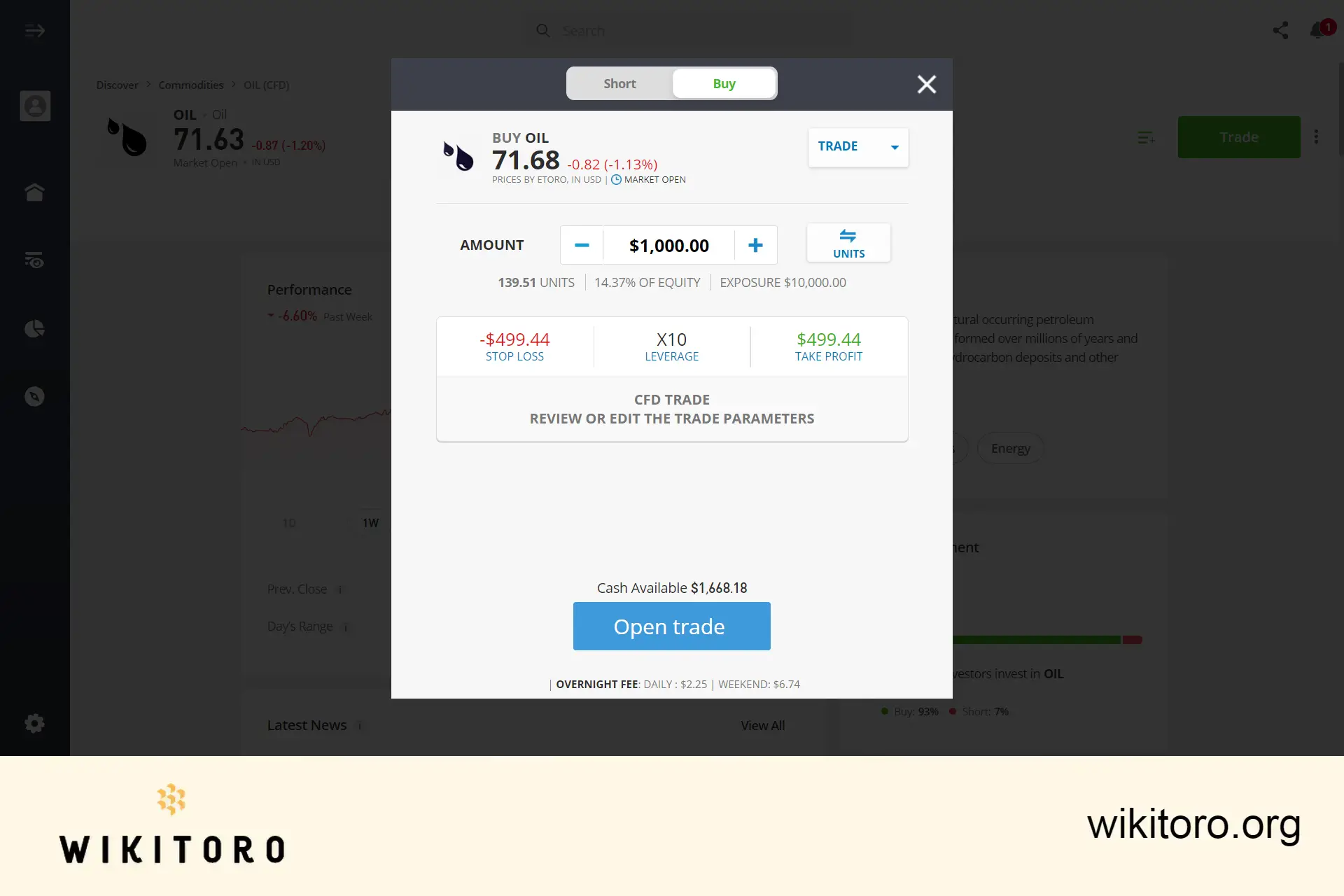
Before opening a trade, pay attention to spreads, overnight CFD fees, and leverage. Spreads are variable and can widen in volatile markets, while overnight and weekend fees may apply if a CFD position stays open. Availability can also depend on where you live, because CFD access is not uniform across all regions.
Oil often draws more attention during geopolitical shocks because price swings get larger. That can create opportunity for traders who want exposure to a fast-moving market, but it also raises the chance of getting caught on the wrong side of a sudden move.
War-driven oil moves can reverse hard on a single headline. A ceasefire rumor, a pipeline update, a reserve release, or a change in military posture can move the market quickly in either direction.
There is also overnight gap risk. If you hold a leveraged CFD position while major news breaks outside market hours, the next tradable price may be far from where you expected. Emotional trading is another problem. Fast markets tempt people to chase moves after the biggest candles have already printed.
What to watch next
Watch these closely over the next few days:
✅ developments in the Iran conflict
✅ any update on the Strait of Hormuz
✅ producer or emergency stock responses
✅fresh oil inventory data
✅Brent and WTI price action, especially around new headlines
If you want to follow oil price moves more closely, eToro is one platform where eligible users can explore oil-related trading instruments. Check whether oil trading is available in your country, review the fees, and understand the risks before opening a position.
eToro is a multi-asset platform which offers both investing in stocks and cryptoassets, as well as trading CFDs.
Please note that CFDs are complex instruments and come with a high risk of losing money rapidly due to leverage. 52% of retail investor accounts lose money when trading CFDs with this provider. You should consider whether you understand how CFDs work, and whether you can afford to take the high risk of losing your money.
This communication is intended for information and educational purposes only and should not be considered investment advice or investment recommendation. Past performance is not an indication of future results.
Copy Trading does not amount to investment advice. The value of your investments may go up or down. Your capital is at risk.
Don’t invest unless you’re prepared to lose all the money you invest. This is a high-risk investment and you should not expect to be protected if something goes wrong. Take 2 mins to learn more.
Crypto investments are risky and may not suit retail investors; you could lose your entire investment. Understand the risks here https://etoro.tw/3PI44nZ.
eToro USA LLC does not offer CFDs and makes no representation and assumes no liability as to the accuracy or completeness of the content of this publication, which has been prepared by our partner utilizing publicly available non-entity specific information about eToro.